
ISRU basics: why living off the land is the whole business
In-situ resource utilization, explained from the mass budget up. Start here if you read nothing else.
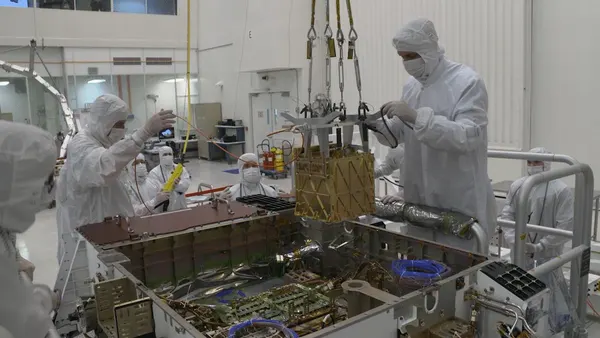
In-situ resource utilization, or ISRU, is NASA’s term for making what you need from what’s already at the destination: water from lunar ice, oxygen from rock or from the Martian air, building material from loose soil. NASA’s own ISRU overview frames it as a way to cut how much has to be launched from Earth, and that framing is the right one. Space mining, for the next decade at least, is a logistics business wearing a hard hat.
Start with the mass. Almost everything a crew uses by weight is boring: water, oxygen, propellant, shielding. None of it is exotic. All of it is heavy. Every kilogram of it that doesn’t have to ride up out of Earth’s gravity well is a kilogram of launch you didn’t buy, and on a round trip the savings compound, because propellant for the trip home is itself mass you would otherwise haul outbound.
That is why the first ISRU products everyone draws are oxygen and water, and why precious metals sit at the bottom of serious roadmaps. Oxygen is the bulk of a methane-oxygen or hydrogen-oxygen rocket’s propellant load by mass. Make it locally and the ship that lands only needs to carry the smaller fuel fraction, or none at all if there’s water to split for hydrogen.
There are really three feedstocks. Ice, found in permanently shadowed craters at the lunar poles and under the surface at mid-latitudes on Mars. Regolith, the loose broken rock everywhere, which is mostly metal oxides and therefore mostly oxygen by mass. And atmosphere, which only Mars has in useful form: thin, but mostly carbon dioxide.
What has actually been demonstrated off Earth is small. NASA’s MOXIE made 122 grams of oxygen on Mars across 16 runs, peaking at 12 grams an hour at 98 percent purity or better. A real propellant plant needs output in tonnes. Nobody has yet scooped lunar ice and turned it into anything.
The catch nobody puts on the slide
ISRU only beats shipping when launch is expensive and the plant is cheap to deliver and run. Starship pulls hard on the first half of that sentence. If SpaceX’s 100-plus tonne reusable vehicle reaches high flight rates, shipping water from Earth gets cheaper, and the break-even for a lunar ice plant moves further out. Cheap launch also makes it cheaper to deliver the plant, so the two effects fight. Which one wins is the most important unanswered number in this field, and we’ll keep coming back to it.
Our view: ISRU becomes a business the first time a mission is designed so that it fails without local propellant or oxygen. Until then it’s a technology demonstration, however well funded.
What would change our mind: a credible cost study showing a small lunar oxygen plant beating Starship-delivered oxygen at modest flight rates. We’d read it closely.
Not affiliated with NASA, SpaceX or any agency or company mentioned. Not investment advice. Disclaimer.